
Cloud and DevOps
We set up infrastructure that a small team can operate confidently: reproducible environments, deployments that are boring to run, and enough visibility to answer "what changed?" without guesswork.
What you get
Environments you rebuild, not remember
Infrastructure defined as code, so a staging environment is reproducible and a recovery is a procedure rather than an archaeology exercise.
Deploys that are boring
Test and ship on merge, with staged rollout and a rehearsed way back. Frequent releases are only safe when a release is unremarkable.
Spend you can attribute
Cost measured per environment and per workload, including the GPU and inference spend AI features add, so a bill can be explained and acted on.
How we approach it
In practice that is infrastructure defined as code so an environment can be rebuilt rather than remembered, a pipeline that tests and ships on merge, logs and metrics that are actually queryable, and alerts that fire on things a person should wake up for and nothing else. The aim is a deploy that is unremarkable, because that is what makes frequent releases safe.
Cost is part of the design. AI workloads in particular make it easy to spend badly — idle GPUs, oversized instances, a retrieval step calling a model it did not need to — so inference and storage spend get measured and attributed from the start rather than discovered on an invoice.
Problems this solves
Servers nobody dares touch
A machine configured by hand years ago, with no record of how, is both a single point of failure and a blocker on every change around it.
Alert fatigue
When everything pages, nothing does. Alerts have to correspond to things a person should act on, or they get muted and the real one is missed.
A cloud bill nobody can explain
Idle instances, oversized databases and forgotten environments accumulate. Without tagging and attribution, cost reduction is guesswork.
How we work

Ideate
We collaborate with clients to define goals, explore ideas, and create a clear plan for a successful software solution.

Develop
Our team builds robust, scalable applications using modern technologies and best development practices.

Maintain
We provide ongoing support, updates, and optimizations to ensure your software remains reliable and efficient.

Scale
We help your solution grow with your business by enhancing performance, adding features, and supporting larger user bases.
What this includes
Products we designed, built, and still run.
Our portfolio showcases projects delivered with expert craftsmanship and exceptional quality.
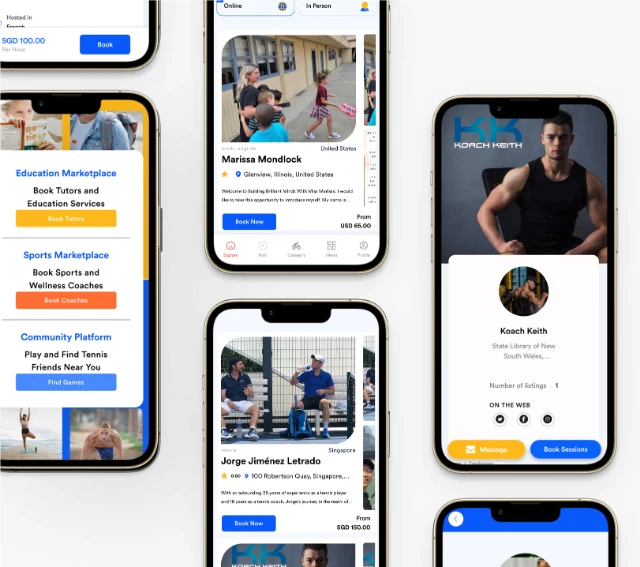
Booking platform for sports, wellness and tutoring
A booking platform where customers find verified sports, wellness and tutoring experts, see real-time availability and pay in one flow.
- React Native
- Node.js
- MongoDB
- Stripe

Housing platform for educators
Affordable housing discovery for teachers, with mapped inventory, eligibility screening and landlord onboarding.
- React
- Express
- PostgreSQL
- Mapbox

New & preloved fashion marketplace
Seller onboarding, condition grading and an editorial storefront tuned for mobile-first browsing.
- React
- Node.js
- Stripe
- AWS
Questions we get asked
Which cloud do you work with?
AWS most often, and we work with whatever you are already on rather than proposing a migration for its own sake. Moving clouds is justified by a specific constraint — a managed service you need, a compliance requirement, a cost structure that does not work — not by preference.
How do you handle secrets and access?
Secrets in a managed secret store, never in the repository, with separate credentials per environment and no shared human logins to production. Access is scoped to roles, rotation is possible without a deploy, and what was granted to whom is recorded. This is also where most real incidents start, so it gets attention early.
What does observability actually include?
Structured logs you can query, metrics for the handful of numbers that describe health, traces where a request crosses services, and alerts tied to user-visible symptoms rather than machine statistics. The test is whether you can answer "what changed?" during an incident without guessing.
Can you reduce what we are spending now?
Usually, and the first step is attribution rather than cuts: tag resources, find what is idle, oversized or forgotten, and look at data transfer and storage tiers, which are where surprises hide. We would rather show you the breakdown and let you decide what is worth keeping than switch things off and find out.